Headquartered in Pittsburgh, Pennsylvania Call us: 888-255-2401

Who Are the Top Bulk Chemical Distributors in the U.S. for Solvents, Acids, and Glycols?

The largest bulk chemical distributors serving U.S. solvent, acid, and glycol buyers are Brenntag, Univar Solutions, IMCD, and Hawkins, alongside mid-market national distributors such as RightPath Industries. Global players win on sheer scale; mid-market distributors win on order flexibility, no-minimum programs, and direct account access. The right choice depends on your volume, lead-time tolerance, and how many SKUs you want on one invoice.

“Top” is not one list. A buyer pulling 40,000 gallons of glycol a month and a buyer pulling four drums of nitric acid a quarter are shopping in different markets, even though both search the same phrase. This guide separates the tiers, states what is publicly verifiable about each major distributor, and gives you the shortlisting criteria that actually predict whether a supplier will perform.

Who are the major bulk chemical distributors in the U.S.?

The U.S. chemical distribution market was estimated at roughly $28.03 billion in 2023 and remains fragmented — no single distributor holds a dominant share. The table below lists the most frequently shortlisted names and the publicly reported facts behind them.

Distributor Headquarters Scope Publicly reported fact Typically best fit for
Brenntag Essen, Germany Global, 70+ countries World’s largest chemical distributor; approximately $16.8 billion in 2024 sales Very high-volume, multi-country programs
Univar Solutions Downers Grove, Illinois Global, North America–weighted Acquired by Apollo-managed funds in an all-cash transaction valued at ~$8.1 billion, completed August 1, 2023; now privately held Large national accounts with dedicated terminals
IMCD Rotterdam, Netherlands Global specialty Specialty-and-formulation focused rather than commodity bulk Formulated specialty ingredients, technical service
Hawkins, Inc. Roseville, Minnesota U.S. regional Publicly traded (NASDAQ: HWKN); strong water-treatment franchise Municipal water and regional Midwest supply
RightPath Industries Pittsburgh, Pennsylvania U.S. national, mid-market 8,000+ chemicals sourced; recognized as a top-10 U.S. ethanol distributor Mid-market plants needing flexible order sizes and one invoice across categories
Figures reflect publicly reported company and market data; verify current numbers before using them in a business case.

Notice that four of the five entries above are not interchangeable. Brenntag and Univar are scale plays. IMCD is a specialty play. Hawkins is a regional play. Treating them as one shortlist is the most common mistake in chemical procurement.

What is the difference between a global distributor and a mid-market distributor?

Scale buys terminal density and contract leverage. It does not buy responsiveness. Mid-market distributors compete on the variables that scale players deliberately standardize away: minimum order quantities, quote turnaround, and whether a named human answers the phone at 6 a.m. when a line is down.

Variable Global distributor Mid-market national distributor
Minimum order Often enforced by tier; small orders deprioritized Frequently drum-level or no formal MOQ
Quote turnaround Days, routed through pricing desks Often same-day from a named rep
Account contact Territory rep plus call center Direct line to a specific account manager
Terminal network Owned, multi-region Mixed owned and partner terminals
Category breadth on one PO Broad, but often split across business units Solvents, acids, and glycols consolidated on one invoice
Credit terms Standardized, often Net 30 with credit review Net 30 available; faster onboarding

If your annual spend runs into eight figures across multiple continents, the scale players are the correct answer. If your spend is concentrated in one to five U.S. plants, the mid-market tier usually delivers better landed cost, because freight consolidation and packaging flexibility matter more than list price. That arithmetic is worked through in our guide to the true landed cost of bulk chemicals, and you can model your own scenarios with the RightPath calculators.

How do you shortlist a bulk distributor for solvents, acids, and glycols?

Six criteria separate distributors that perform from distributors that quote well:

  1. Category coverage on one PO. Solvents, acids, and glycols are handled by different business units at many distributors. Confirm one rep can quote all three. RightPath covers bulk solvents, bulk acids, and bulk glycols under one account.
  2. Packaging range. Ask whether the distributor can move you between drums, IBC totes, tank truck, and railcar without changing suppliers. Packaging economics shift sharply with volume.
  3. Documentation on demand. COA and SDS should be retrievable without a support ticket. Lot traceability should be standard, not a premium service.
  4. Backup supply. Ask directly what happens when the primary source allocates. A distributor without a second source is a single point of failure.
  5. Quote transparency. Demand line-item freight, surcharges, and demurrage terms. All-in quotes are comparable; base-price quotes are not.
  6. Compliance credentials. Covered in the next section.

For the full evaluation framework — scorecards, reference questions, and contract terms — see How to Choose a Bulk Chemical Distributor. If you are weighing whether to run one distributor or several, read Should You Consolidate Chemical Suppliers?

What credentials should a bulk chemical distributor have?

Three credential sets are non-negotiable for hazardous bulk chemicals.

Responsible Distribution. The Alliance for Chemical Distribution (ACD, formerly the National Association of Chemical Distributors) requires member companies to comply with its Responsible Distribution program — a mandatory set of environmental, health, safety, and security codes covering risk management, carrier selection, job procedures and training, emergency preparedness, and product stewardship. Verification requires a third-party audit. Ask whether a distributor is verified, not merely a member.

Hazard communication. Every distributor shipping hazardous chemicals in the U.S. must comply with the OSHA Hazard Communication Standard (29 CFR 1910.1200), which governs GHS-format labels and safety data sheets. A distributor that cannot produce a current SDS on request is not compliant.

Transportation. Bulk solvents and acids are regulated hazardous materials under DOT/PHMSA rules, which set the UN number, packing group, and placarding for every shipment. Confirm the distributor’s carriers are hazmat-qualified rather than brokered ad hoc.

Where does RightPath Industries fit on this list?

RightPath Industries is a Pittsburgh-headquartered national distributor built for the mid-market gap: buyers too large for a lab supply catalog and too small to be a priority account at a global distributor. RightPath sources more than 8,000 chemicals and has been recognized as a top-10 ethanol distributor in the United States, with solvents, acids, and glycols consolidated on a single account.

The practical differences show up in the terms: same-day quotes on in-stock material, no minimum-order walls, Net 30 credit terms for qualified accounts, and all-in pricing with freight itemized rather than buried. Browse the full product line card or the bulk chemical distributor overview to see the coverage. For ethanol specifically, see the 2026 bulk ethanol supplier guide.

Frequently asked questions

Who is the largest chemical distributor in the United States?

Brenntag is the world’s largest chemical distributor by revenue, reporting approximately $16.8 billion in sales in 2024, and it operates extensively across North America. Univar Solutions, headquartered in Downers Grove, Illinois, is the largest U.S.-headquartered player and was taken private by Apollo-managed funds in a transaction valued at roughly $8.1 billion that closed on August 1, 2023.

Can one distributor supply solvents, acids, and glycols on the same order?

Yes, but not all of them will. Many large distributors split these categories across separate business units with separate reps and separate invoices. Mid-market distributors typically consolidate all three on one purchase order, which reduces freight cost and eliminates split-shipment coordination.

Do bulk chemical distributors require minimum order quantities?

It varies by tier. Global distributors commonly enforce volume minimums or deprioritize small orders through pricing tiers. Some mid-market distributors, including RightPath Industries, operate without formal minimum-order requirements, allowing drum-quantity purchases alongside tank-truck volumes on the same account.

What certifications should I require from a chemical distributor?

Require ACD Responsible Distribution verification, documented OSHA Hazard Communication compliance under 29 CFR 1910.1200 with current SDS availability, and DOT/PHMSA-qualified hazmat transportation. Add lot-level traceability and certificate of analysis access as standard contract terms.

How do I compare quotes from different chemical distributors fairly?

Compare landed cost, not unit price. Normalize every quote to the same delivered basis by adding freight, fuel surcharges, packaging, demurrage or detention exposure, and any minimum-order penalty. A quote that looks 6% cheaper per gallon frequently loses once truck-versus-rail freight and container returns are included.

Get a comparable quote

The fastest way to test any distributor is to run one line item through their quoting process and see what comes back. Request pricing from RightPath Industries for an all-in, line-itemized quote on bulk solvents, acids, or glycols. More procurement guides are indexed in the Chemical Guides library.

High Purity Solvents Order Online

We here at RightPath Industries would like to think of us as synonymous with high purity solvents. We have recently updated our website and even created a separate secure online store for ordering all of your high purity solvents.  You can now order all of your high purity solvents through highpuritysolvent.com which is part of RightPath Industries.  You can also request custom pricing by simply contacting us.  We often have sales on our website so it is advisable to check often or contact us if we do not offer something that you might be looking for.  All of our chemicals can be drop ins and direct replacements for other brand name products that you are simply paying too much money for.  We believe in building long standing business relationships with our customers and pricing products too high is not one of our goals however saving you time and money is.  By working with RightPath industries for you high purity solvent needs you can not only save just time by ordering many of your items in one place with RightPath Analytical and our high purity solvents but you can also save money.  Our pricing is far below in the industry averages and we specifically cater to smaller to medium size laboratories.  Please feel free to give us a call and see how we can save you money not only today but far into the future as well.

highpurity-solvent-300x177 High Purity Solvents Order Online
RightPath Industries High Purity Solvents

Order Online

Caution with Chemicals in the Workplace

When working in any industry where a serious accident could occur on the job, safety is absolutely paramount. This is especially true if your line of work finds you in a laboratory working with dangerous and/or sensitive materials such as chemicals. However, not all laboratories or lab managers are as thorough with safety training as is needed, and some researchers may not be as attentive as they should be during training. Nevertheless, safety remains a top concern for those working in these particular fields, so we’ve gathered some data on the industries that see the most injuries and have put together some tips to always keep in mind when working with hazardous chemicals in the workplace. Caution-with-Chemicals-in-the-Workplace Caution with Chemicals in the Workplace

Know the label before you open the drum

Under OSHA’s Hazard Communication Standard (29 CFR 1910.1200), every workplace chemical container must carry a GHS label: product identifier, signal word, hazard pictograms, hazard statements, and precautionary statements. Before handling any material, match the label to its Safety Data Sheet and confirm you understand the hazard class — flammable, corrosive, oxidizer, or health hazard. Our guide to reading a GHS label on a chemical drum walks through each element.

The basics that prevent most incidents

  • Ventilation: solvents like acetone, toluene, and MEK generate flammable vapors — work in ventilated areas and keep ignition sources away.
  • Segregated storage: keep acids away from bases, oxidizers away from flammables, and follow the SDS storage section for every product.
  • PPE matched to the hazard: chemical-splash goggles, gloves rated for the specific chemical (nitrile is not universal), and respiratory protection where exposure limits require it.
  • Grounding and bonding: when transferring flammable liquids between containers, ground and bond both vessels to prevent static ignition.
  • Spill readiness: stock compatible absorbents and neutralizers before you need them, and train the team on the spill procedure in your SDS.

Where to get the documentation

Every product RightPath Industries ships includes its Safety Data Sheet, and lot-controlled orders add a Certificate of Analysis. If you need SDS copies, container compatibility guidance, or help classifying a material for your hazard communication program, contact our team — we answer the same day.

Coal Comeback? Coal Testing Outlook and Opportunities

Is the comeback of coal on the horizon.  As many of you have seen President Trump is working on repealing some of the clean air act  laws that lowered the emission rates of CO2 which mainly effected coal fired power plants.  As many of you may also know the large coal and energy companies in the United States do not have the capabilities to test many of their coals in house. This is where specialty laboratories perform in house testing of coal samples and provide those analysis back to the companies requesting testing.  Some of these tests such as the sink and float analysis are tried and true methods that have been used for the past 50 years to analyze coals.  Two of the main materials used in sink and float analsysis are dibromomethane and perchlorethylene.  These are both what are termed as halogenated solvents and are both very dangerous to work with and have been known to cause cancer. This is one reason why RightPath Industries makes all of our customers using halogenated solvents require the filling out of a user agreement form to ensure that staff is properly trained in how to handle the materials.

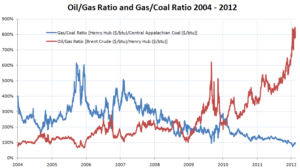
The main reason for the slow demise of coal over the past few years can be viewed as two fold.  One being the clean air act which caused a significant disruption with competitive energy companies in having to provide new scrubbers to be below the new EPA limits.  The second and perhaps the main reason is rise of fractal drilling and the marcellus shale gas reserve. Coal testing laboratories are also feeling the burden of lowered coal usages. There has been a reduction at coal testing labs by over 70% in the past 3 years. Many coal testing labs have since gone out of business due to the low sample request by energy companies.

oilgascoalgasratio-300x168 Coal Comeback? Coal Testing Outlook and Opportunities
Coal vs Gas RightPath Industries

As you can see in the above figure in 2012 Natural gas in 2012 became the predominant source of energy for the United States surpassing coal.  This is mainly due to the large natural reserves and lower costs associated with extraction of coal from the earth utilizing techniques such as fractal drilling which drive the cost down considerably when in comparison with coal.

We believe that while the clean air act redaction might help in the short term for some coal fired power plants overall due to the large and cheap supply of natural gas moving forward coal production and with it ancillary markets and employment in the coal sector will continue to suffer.

As many of our customers in coal country there are still opportunities utilizing current infrastructure in many of the laboratories across the country.  Many coal labs already contain the required staffing as well as testing equipment needed to begin operations in environmental as well as analytical testing services.   If you are looking to make the switch please feel free to contact RightPath Industries and see how our team of experts my be able to help you.


A RightPath Brands Company

How to use our Website?

We have taken a look at other chemical and laboratory supply companies and decided that not every page needed to have 300 links and steer your all over the place.  What we wanted was something complete, concise and to the point when looking for  a product you may need.  All that is needed to find a product on our website is to simple go to the search box at the top or lower right hand side of the page and type in the chemical name of the product you are looking for or the CAS number.  You can also click on products and scroll through our offerings as well. We have done our very best at RightPath Industries to get you to the chemical you may need as quickly as possible.  Please feel free to contact us today to lower your cost of goods for high purity solvents, acids and general chemicals all across the United States

keep_it_simple_by_tomsoncze-d6lh7tm-300x169 How to use our Website?

Login / Register